


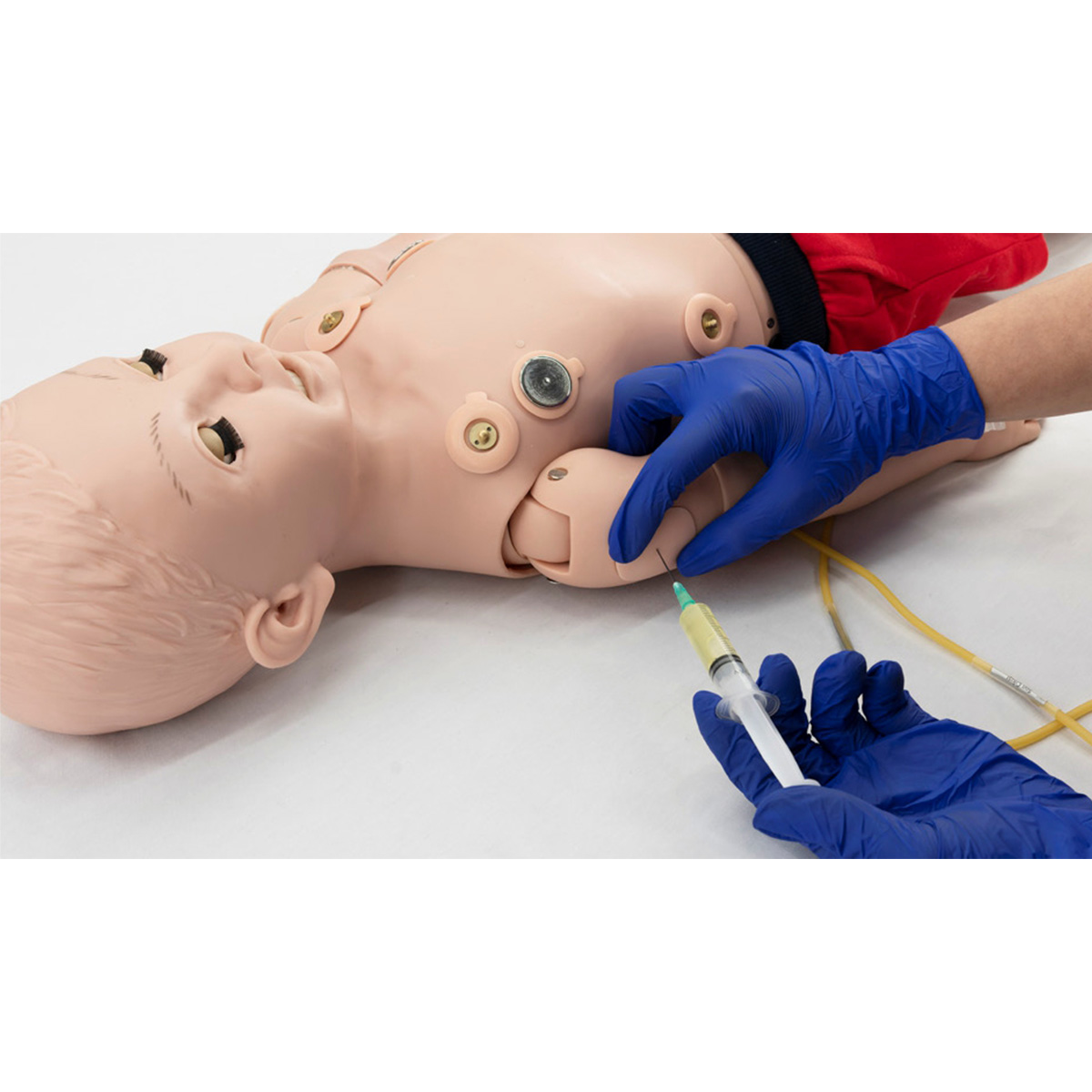


PEDIATRIC LIFE SUPPORT SIMULATOR
The Pediatric Advanced Life Support Simulator is specifically designed to offer comprehensive training in advanced life support for infant and child. The manikin is made of special plastic that is highly durable and resistant to deformation, with elastic material used to mimic realistic skin texture. Its anatomical structure precisely mimics that of a 1-year-old child, ensuring a lifelike and realistic training experience.
Dimensions:
Dimensions: 82(L) X 29(W) X 16(H) cm Weight: 6 kg
Description
Features:
- The manikin features fully movable joints in the neck, shoulders, hips, and knees, allowing for effortless and realistic movement during training.
- A 7-inch tablet is provided to serve as the control panel, enabling wireless management of audio prompts, ECG, and pulse simulations for seamless training.
- The eyes of the manikin can realistically open and close within the eye sockets. Utilizing the provided eye pupil labels, trainers can simulate different states of pupils’ mydriasis.
- The manikin can be narrated through the control panel for a realistic anamnesis practice.
- The airway management system features oral cavity, tongue, teeth, glottis, trachea, esophagus, and both the right and left lungs. The neck and jaw are movable, enabling oral and nasal endotracheal intubation and applications of LMA, LTA, and Combi tubes. When examined with a laryngoscope, the vocal cords are visibly prominent. In case the tube is mistakenly placed in the esophagus with air supplied, significant bloating occurs in the stomach.
- The manikin allows for femoral artery pulse simulation. The pulse rate can be adjusted in synchronization with the selected ECG rhythm.
- CPR can be effectively practiced on the manikin.
- The manikin is equipped with a valve system to prevent the backflow of air during training, ensuring hygiene throughout the sessions.
- Artificial respiration can be performed at lifelike scales using mouth-to-mouth, mouth-to-nose techniques, and a bag-valve mask. Realistic bilateral and unilateral chest rise can be observed during ventilation. Additionally, breath sounds produced during ventilation can be observed.
- The manikin is equipped with 4 ECG points and 2 secure metal points for administering electrical treatments. Defibrillation shocks can be applied to the manikin using a real defibrillator. The manikin is designed to withstand the shocks delivered by the defibrillator.
- The manikin is equipped with 4 ECG points and 2 secure metal points for administering electrical treatments. Defibrillation shocks can be applied to the manikin using a real defibrillator. The manikin is designed to withstand the shocks delivered by the defibrillator.
- The control panel offers a selection of 43 different ECG rhythms with adjustable heart rates, allowing trainers to modify the heart rhythm as needed.
- The manikin is compatible with both simulative and real AED (Automated External Defibrillator) devices, which must be provided separately by the user.
- Learners can practice IV puncture, injection, transfusion, and blood sampling on the bilateral forearms, using the basilic and cephalic veins and the dorsal surface of the hand. The simulation provides a distinct feeling of entry when the needle is inserted into the vein. The procedure can be repeated multiple times for comprehensive practice, and both the skin and blood vessels are replaceable for long-lasting use.
- IM injections can be administered bilaterally to the deltoid muscle in the upper arm and the vastus lateralis muscle in the thigh.
- Intraosseous access can be performed on the right leg. The bone modules can be filled with simulative blood fluid to enhance realism during training.
- The manikin is equipped with a rechargeable battery, making it ideal for field training. It can operate up to 6 hours with a fully charged battery.
Related products


NS/119


